Amber & Jewelry
Amber colors and grades, honestly priced
The palette is real chemistry and honest commerce: clarity, treatment and rarity set the grade, and the grade, not the story, sets the range.
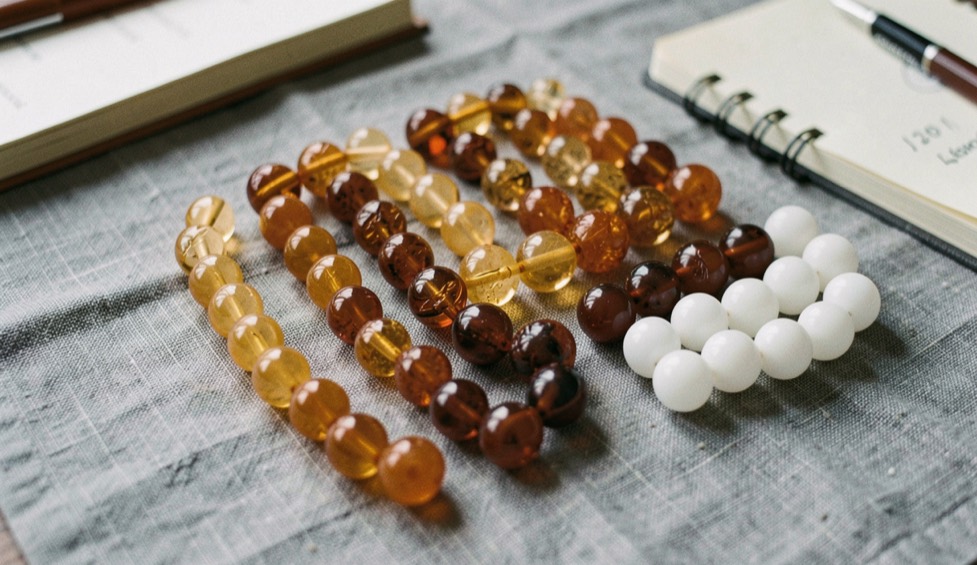
Amber is sold by color the way the sea is sold by weather, and the words on the labels, honey, cognac, cherry, butterscotch, royal white, describe real material in real grades. What the labels rarely say is how each color arises: which shades come out of the ground, which are clarified or deepened by heat, and which rarities deserve their multiples. A buyer who understands the making of a color can read a price list like a book.
Where each color comes from
The natural range runs from opaque milky white through butterscotch and clear honey to deep brown, and the cause is mostly structure: microscopic bubbles and inclusions scatter light, and the more of them, the cloudier and lighter the piece. Bone white amber, sometimes called royal white, is dense with tiny bubbles and is among the scarcer grades; clear honey material, with few bubbles, is the classic transparent look most buyers picture first.
Deep red cherry tones are usually made, not found: gentle heat treatment deepens and clarifies lighter material, a practice old and accepted in the trade when it is declared. Green shades are likewise produced by treating amber under heat and pressure, and they sit in a curious place, popular with buyers though largely a workshop color. Black pieces are not a color at all but material packed with bark and debris, attractive when polished in slices that show the sediment.
Treatments a buyer should expect
Two workshop processes dominate. Clarification drops cloudy pieces into hot oil, which drives the cloud of micro bubbles back toward the center and leaves clear material with, as a side effect, the discs called sun spangles: bright internal cracks that look like petals and are, properly understood, a sign of treatment rather than damage. Heat also deepens tone toward cognac and cherry. Neither process is fraud when disclosed; both become problems when a treated deep red bead is sold as naturally colored.
Reconstruction is the harder line. Pressed ambroid, made from smaller pieces fused under heat and pressure, is a century old legitimate material that must be sold as pressed, and it is the grade that changes the price conversation entirely. Flow lines and rows of elongated bubbles are its fingerprints, visible with a loupe and patience.
How indicative prices track the grades
Ranges on the craft market are wide, and any honest guide repeats that these are indicative, not quotations. Small bead bracelets in ordinary honey tones sit at the accessible end; natural cognac bead necklaces run into real money as size and uniformity grow; treated cherry material often costs less than natural cognac of the same size, which surprises buyers; bone white commands multiples of honey; and insect inclusions price like the specimens they are, from pocket money for a gnat to hundreds and beyond for a complete, well positioned insect.
| Grade | How it arises | What to check | Indicative market band |
|---|---|---|---|
| Clear honey | Natural, few bubbles | Symmetry, few open flaws | Modest for small pieces, rising fast with bead size |
| Cognac | Natural tone, often clarified | Disclosure of heat treatment | The classic bead necklace grade, mid market |
| Cherry, deep red | Heat deepening | Honest labeling as treated | Often below natural cognac of equal size |
| Green | Heat and pressure treatment | Skepticism toward natural claims | Fashion band, wide and uneven |
| Bone white | Natural, dense micro bubbles | Weight, opacity, rarity premium | Multiples of honey per gram |
| Inclusion specimen | Natural, with trapped life | Posture, completeness, no inserted insects | From modest to collector money |
| Pressed ambroid | Fused smaller pieces | Flow lines, aligned bubbles, labeling | A fraction of natural, sized like it |
Reading a tray with the grades in mind
The grades change what questions are worth asking. For honey and cognac, ask about treatment and read the certificate if one exists. For cherry and green, assume treatment and ask that it be declared. For white, verify the material with the standard tests before accepting the rarity premium. For inclusions, spend the time a specimen deserves, checking that the insect sits naturally in the stone rather than in a pocket of inserted clarity.
One habit protects every purchase: compare like with like. A treated cherry bracelet and a natural white pendant are not competitors, and a price that looks high beside one may look fair beside the other.
A collector’s checklist
- Decide the grade you want before the tray, since each grade is its own market.
- Ask whether color is natural or treated, and hear the answer as a credibility test.
- Loupe for sun spangles and flow lines, the honest marks of workshop processes.
- Price specimens by the inclusion, not the gram, and compare completeness.
Common mistakes
- Paying a natural color premium for cherry or green, shades that treatment makes routinely.
- Mistaking sun spangles for damage, or worse, for proof of age.
- Buying white amber on faith, when the rarity premium deserves the full test sequence.
- Comparing a treated fashion piece with a natural specimen and concluding either is a cheat.
The bottom line: color is a menu of chemistries, not a hierarchy of beauty. Choose the grade that matches your budget and your curiosity, demand disclosure of treatment, and let clarity, not the label, carry the price.