Food & Tea Gifts
The samovar and the tea table it built
A charcoal stove that pours: the samovar organized a whole domestic ritual, and its metals and stamps make it one of the most readable antiques.
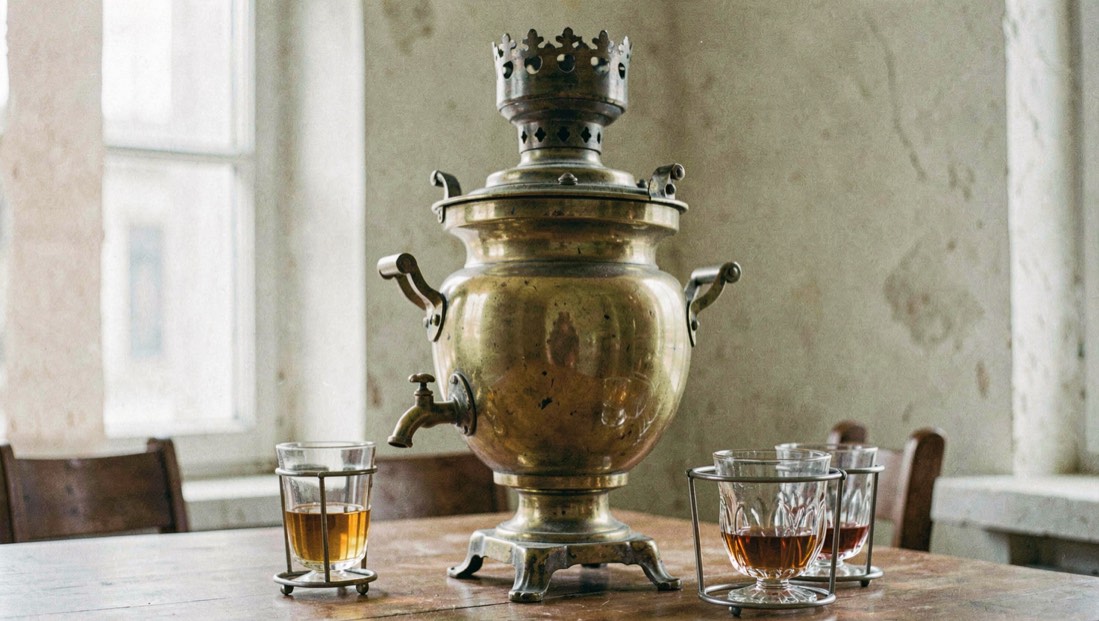
The samovar is a kettle that decided to be furniture. A charcoal fire burns in a central tube; the water jacket around it boils; a tap pours; and a family sits around it longer than the tea lasts. Invented into its classic form in the late eighteenth century and industrialized by the metal workshops of Tula, it organized the Russian tea table for a century and a half, and it survives as one of the most legible antiques of domestic life: metals, forms and factory stamps all tell their story plainly.
Tula and the workshops
The documented starting point is Tula, the arms making town south of Moscow, where the first recorded samovar workshop was opened in 1778 by the Lisitsyn brothers, Ivan and Nazar. From that workshop the trade grew explosively: by the middle of the nineteenth century Tula held dozens of samovar factories, and names like Batashev became brands so trusted that their stamps were copied, which is itself a lesson in how to read one. The town supplied the empire, and the samovar became the centerpiece of urban parlors and railway stations alike.
Forms multiplied with the trade. The classic shapes carry names of their own: vase, barrel, egg, acorn, goblet, and the tall fluted church form. Bodies were raised, spun or stamped from sheet; the best pieces were hand planished and engraved. A samovar is a technical object, and its parts have names a buyer learns quickly: the fire tube down the middle, the crown and blower at top, the vent and chimney cap, the tap, called the kranchik, the handles, the base tray and the little cap for the chimney.
The ritual around the metal
The samovar shaped how tea was drunk. A strong concentrate, the zavarka, stood in the pot on the crown, kept hot by the rising heat; each glass was poured a finger of concentrate and diluted with boiling water from the tap to taste. Tea arrived in Russia in the seventeenth century and was established in households by the nineteenth, and the samovar made it social: the water stayed hot for hours, and the table stayed crowded.
A working tea samovar furred with limescale is treated with equal parts water and white vinegar brought to the boil then left for thirty minutes before three rinses. The workshops of Tula built these water jackets for daily zavarka service, and bodies stamped by Batashev makers stayed in use through constant refilling. The method with exact white vinegar proportions explains the boil, the rest and the final clear water heating to discard.
Two service objects belong to the picture. The podstakannik, the engraved metal holder for a faceted glass, made tea portable, above all on trains, where a glass in a silvered holder became the shared image of Russian travel. And the porcelain of the table, from Gzhel cups to imperial factory services, carried the ritual at its best, which is why these crafts meet on one table.
Reading metals and marks
Collectors sort samovars first by metal. Red copper conducts beautifully and was the premium metal; brass, a copper zinc alloy, dominated the trade with its warm yellow tone; tombak, a brass rich in copper, wears a redder dress; and later pieces appear in nickel silver and cupronickel, whiter metals of the machine age. A magnet helps sort the base metal under a plated skin, since steel answers and brass does not. Weight warns too: a genuine body has heft, and a light vase shaped object with modern solder is a reproduction waiting to be measured.
Marks reward patience. Factories stamped the crown or the body with the maker, the town and often an award line; the Batashev name, for instance, carries a documented history and a crowd of imitations, so stamp detail matters. Repairs tell their own truth: old solder around the tap or seams is a century of use, not a defect to hide, while bright modern solder on a claimed antique is a story wearing a costume.
| Metal | Look | What to check |
|---|---|---|
| Red copper | Deep warm tone, premium heat | Old solder, even planishing, honest patina |
| Brass | Yellow, the trade standard | Factory stamp on crown or body, heft |
| Tombak | Reddish brass of finer pieces | Engraving quality, applied ornament |
| Nickel silver, cupronickel | White metal of the later era | Machine era details, plated seams |
| Any, under plating | Magnet test at a hidden point | Steel answers the magnet, alloys do not |
Living with a samovar today
An antique charcoal samovar is displayed, not fired: its solder seams were never meant for modern safety expectations, and collectors keep the ritual by pouring from a kettle. Patina is the object’s biography and should be kept, not polished away; light cleaning with soft cloth and metal care designed for the specific alloy, brass polish for brass, is enough. Electric conversions from the Soviet decades are common and honest, and they price differently from untouched charcoal pieces, which is information, not a flaw.
A collector’s checklist
- Identify the metal first, and confirm it with a magnet at a hidden spot.
- Find the factory stamp and read it against documented makers before paying a name.
- Expect heft, and weigh any piece whose story is heavier than its body.
- Keep patina, and treat bright modern solder as a question the price must answer.
Common mistakes
- Polishing away a century of patina, the one thing no workshop can sell you back.
- Lighting an antique, whose solder was never tested against modern use.
- Paying for the Batashev name from a stamp, when a loupe shows a cast copy.
- Buying a reproduction for display at antique prices, when a magnet and a scale would have voted no.
The bottom line: the samovar is the most mechanically honest craft on this site. Metal answers a magnet, stamps answer a loupe, and patina answers a decade; read the object, and the tea table it served comes with it for free.
Cleaning a brass body without lifting its engraving, or a lacquered tray without dulling its shine, is reversible work when the method is right and damage when it is guessed, and the sequence for lacquered wood, amber, porcelain and wool is set out in the care guide for the shelf.
Hard water works the same way on a kettle, a tap and a shower screen, and the routine that lifts limescale without scratching, along with the laundry and kitchen smells that come with it, is gathered in the household cleaning notes.
Tea glasses and window panes share one enemy, condensation that dries into a film, and the checks to run before signing for new frames and glazing are set out in the window contract checks.
Keeping brass bright at home is a small version of a larger craft, and the order of work, products and controls behind professional cleaning are described in the professional cleaning methods.