Matryoshka & Dolls
Genuine or souvenir: reading a matryoshka in hand
A nesting doll testifies on its own body: the wood, the seam, the varnish and the base each answer one question, and together they settle the price.
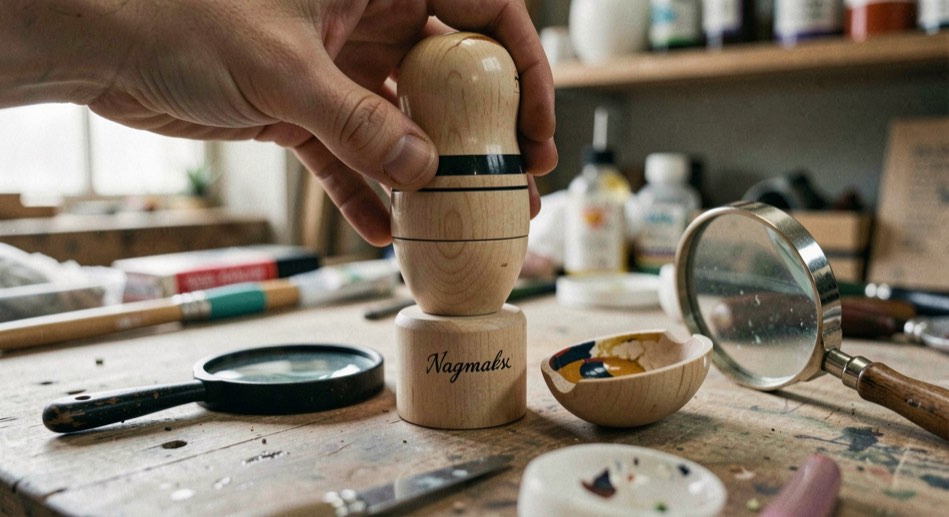
Two dolls can stand side by side, wear the same rose and cost ten times apart, and the difference lives in facts you can check in two minutes. Hand turned wood against stamped blanks, hand painting against airbrush, lacquer applied by brush against a spray booth, an artist’s signature against a paper sticker: none of these signs is hidden, and none requires expertise. This guide walks the doll from base to crown and prices what you find.
Start with the wood
Serious sets are turned from linden, with birch as the other documented choice, and the timber is air dried for a long period before the lathe, traditionally up to two years, so the finished figure does not crack in a heated room. Pick a figure up: properly dried linden feels dense for its size and carries a faint sweetness of wood under the lacquer. Turn the base: hand turning leaves a clean circle, often with the faintest tool path visible under the finish, and the wood grain should read through a thin coat, not disappear under plastic gloss.
Weight is evidence too. Thin, quick souvenirs feel light because they are made light, and lightness in a nesting doll usually means less wood inside the wall, which means a figure that chips and dries out. A well turned set feels composed in the hand, stable on its base, and quiet when shaken: a loose inner figure rattling inside an outer one is a turning fault, not a charm.
Read the seam and the fit
The first opening is the exam. A well made set separates with a clean, slight resistance and closes with an even line, because the lathe cuts both halves of a joint at once. Factory stock often shows a visible step at the seam, a wobble in the line, or a dry creak. Open halfway and look at the rim: the edge should be thin and even, sanded smooth, with no glue traces and no bright raw wood where paint gave up.
Work down the set. Every seam in a quality set behaves like the first, and the smallest figures should still be real objects, turned and painted rather than left as pebbles. Uneven behavior between pieces, one perfect and three careless, says assembly work: pieces bought in batches and finished by different hands.
The painting and the lacquer
Hand painting shows irregularity with intention: brushstroke boundaries where color changes, small asymmetries between the two cheeks of a face, highlights placed by judgment. Airbrushed faces, by contrast, arrive with a doll like sameness, soft edged shading repeated identically across the set. Under a low power loupe, a printed transfer betrays itself in a regular dot pattern no brush produces, and identical flower placement across all figures of a large set says printing, not painting.
Lacquer finishes the argument. Workshop pieces carry several thin coats, polished to a soft sheen that lets wood breathe through; tourist stock often wears one thick glossy coat that pools at the seam and rings when tapped. Smell matters at this point: a chemical varnish odor that survives the shop means a finish applied in haste.
The base tells the truth
Turn the figure over and you have the last witness. Workshop and author pieces carry a signature, often with the town and a date, painted or burned into the wood; many studios add a stamp as well. Paper stickers, especially glossy ones naming famous towns, are the signature of a trading company, not a painter, and a sticker does not raise price the way a signature does.
| Signal | Workshop piece | Mass souvenir |
|---|---|---|
| Wood and weight | Dense dried linden or birch, grain visible | Light, thin walled, anonymous pulp feel |
| Seam and fit | Clean resistance, even line, quiet interior | Visible step, wobble, rattle |
| Painting | Stroke boundaries, deliberate asymmetry, varied faces | Airbrush sameness or printed dot pattern |
| Lacquer | Thin polished coats, soft sheen | One thick gloss, pooled edges, chemical smell |
| Base | Painted or burned signature, town, date | Paper sticker of a trading company |
| Indicative price | Roughly 60 to 250 for five to seven pieces, author sets above 300 | Roughly 10 to 30 for small sets |
A collector’s checklist
- Lift, weigh and listen: dense wood, stable base, no interior rattle.
- Open every seam, starting with the first, and read the rim of each half.
- Search the faces for stroke boundaries and asymmetry, the fingerprints of a brush.
- Check the base for a signature before trusting any story attached to the set.
Common mistakes
- Paying author prices for a sticker, when the painted signature is the credential.
- Trusting glossy shine as quality, when the best lacquer is thin and quiet.
- Buying by piece count, which the factory chooses, instead of brushwork, which the painter chose.
- Testing only the outer figure, when inner seams and faces show the workshop’s real pace.
The bottom line: buy with the set open and the base turned toward you. Five checks, two minutes, and the price either stands or falls; a genuine hand painted matryoshka is never afraid of the examination it was built to pass.