Matryoshka & Dolls
Three workshop styles and how to tell them apart
Same toy, three accents: the workshop towns never agreed on shape, palette or flower, and that disagreement is the collector’s best map.
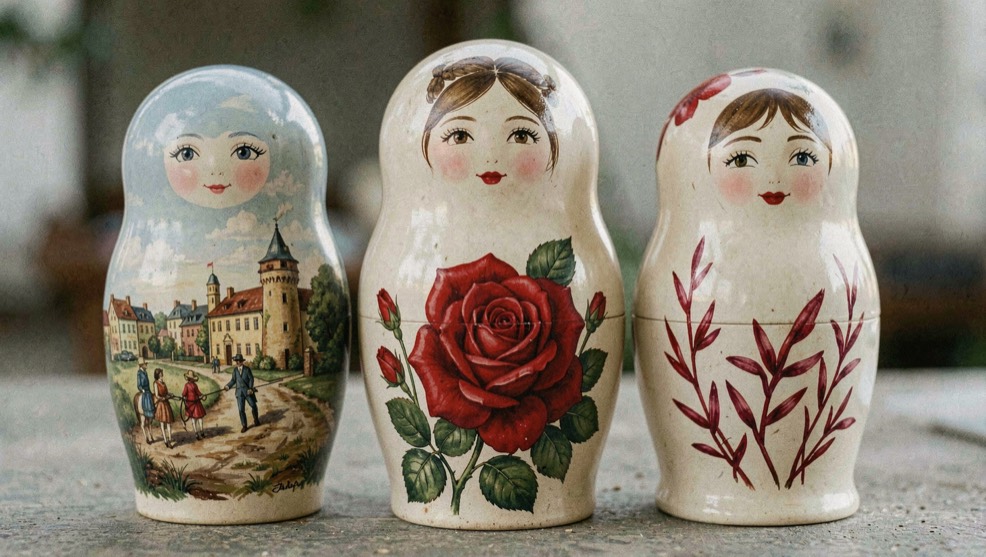
Ask three collectors what a matryoshka looks like and you will get three honest answers, because the workshop towns built different dolls. Sergiev Posad painted scenes and burnished gold. Semyonov grew enormous roses from thick based bodies. Polkhovsky Maidan answered with slender cones of crimson and blue. None of this is decoration trivia: the styles are documented, they are learnable, and a buyer who can name them can price a doll without a price tag.
Sergiev Posad: the pictorial school
Sergiev Posad, the town where production concentrated after 1900, inherited the painterly ambition of the first sets. Its dolls tend toward rounded, generous forms, and the painting behaves like small scale picture making: figures, buildings, fairy tale scenes and everyday subjects rendered in gouache, often with burnished gold accents on headdress and apron. Where other schools decorate a doll, the Sergiev Posad school illustrates on one.
The practical sign is density of subject. A set where each doll carries a different scene, with deliberate composition rather than repeated ornament, is speaking the oldest dialect of the craft. Under its Soviet era name of Zagorsk the school continued this line, which is why older catalogues list Zagorsk style and newer ones say Sergiev Posad for the same tradition.
Semyonov: the rose factory
Semyonov, in the Volga region east of Moscow, industrialized the doll without abandoning hand painting. Its makers turn the wood with a deliberately thick base so the figures stand firmly, and they paint in bright aniline colors, dominated by a large spreading wild rose that sweeps across apron and skirt. The painting tradition here works from the flower outward, without a preliminary pencil sketch, and a single set can hold a dozen or more pieces.
Two signs confirm a Semyonov pedigree: the heavy, stable base on every figure, and the rose that anchors the composition. The town’s factories also pushed piece counts further than anyone, and museum grade sets with dozens of figures came out of Semyonov in the Soviet decades, culminating in famous exhibition sets of the 1970s.
Polkhovsky Maidan: crimson and blue
The third great center grew from villages in the south of the Nizhny Novgorod region, above all Polkhovsky Maidan and neighboring Krutets. The form is the slimmest of the three, a tall cone with a small head, and the palette is unmistakable: strong crimson and magenta roses with leaves in clear blue and green, painted without outlines so colors meet wet in wet, then sealed in glossy lacquer.
A fourth accent is worth knowing for completeness: the Kirov, or Vyatka, school decorates its dolls with fine inlay work in straw, a technique no other center uses. It is rarer on the souvenir market and easy to recognize, since no painted flower can imitate the sheen of split straw laid in patterns.
| Style | Shape | Palette and motif | Reliable sign |
|---|---|---|---|
| Sergiev Posad, once Zagorsk | Rounded, generous, larger head | Gouache scenes, figures and buildings, burnished gold accents | A different composed scene on each figure |
| Semyonov | Thick stable base, classic profile | Aniline brightness, one large wild rose sweeping the body | Heavy standing base, rose anchored composition |
| Polkhovsky Maidan | Slender cone, small head | Crimson and magenta roses, blue and green leaves, no outlines | Wet in wet color joins under glossy lacquer |
| Kirov, or Vyatka | Varies | Straw inlay patterning over painted ground | Split straw sheen no brush can imitate |
Using the map in a market
The styles answer the first question a buyer should ask: does this doll know what it is? A set announced as Semyonov should show the rose and the heavy base; a set claimed as Sergiev Posad work should show composed scenes, not a decal of flowers. Mismatch between label and style is not proof of fraud, since painters move and mixing happens, but it is a reason to look closer before paying workshop prices.
The map also protects against the opposite error: rejecting a fine doll because it fails a checklist written for another school. A slender crimson cone is not a bad Semyonov, it is a good Polkhovsky Maidan.
A collector’s checklist
- Read shape first: rounded and pictorial, thick based and floral, or slender and crimson.
- Match the palette to the school before reading any label on the base.
- Count piece count as a factory signature, not a quality score.
- When style and claimed origin disagree, ask why, and price the uncertainty.
Common mistakes
- Judging every doll by the Sergiev Posad standard, and dismissing honest Semyonov or Maidan work.
- Trusting the biggest set on the table, when piece count is a factory decision, not a craft verdict.
- Confusing the bold Maidan rose with the Semyonov rose, which are taught by different palettes.
- Buying the label instead of the object, when the object itself carries the school in shape and color.
The bottom line: choose the school you want to live with, then buy the best execution of it. A settled collector owns three accents, not thirty dolls; a settled buyer pays for brushwork inside one honest tradition.