Painted Crafts
Khokhloma: how wood learned to shine like gold
No gold is used and everything shines: khokhloma is a chemistry trick, an icon painter’s inheritance and one of the great wooden crafts of Europe.
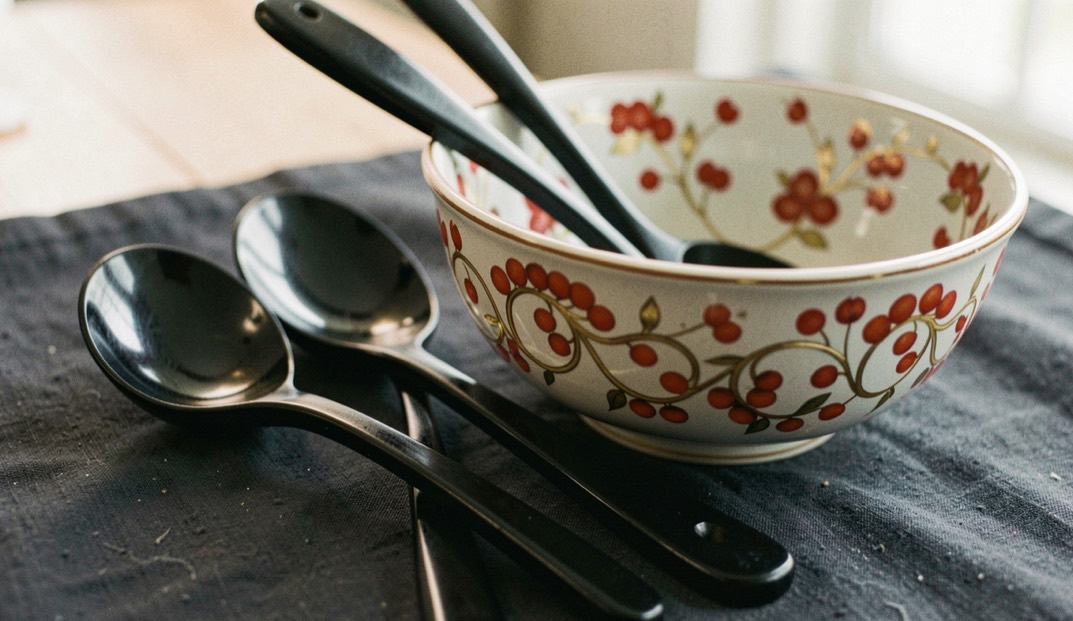
Khokhloma is the craft that pretends to be rich. A wooden spoon or bowl, painted in red and black and fired under lacquer, comes out of the furnace shining like gilded metal, and has since the seventeenth century convinced dinner tables it is worth more than its material. The trick behind the shine is documented and repeatable, which is what makes khokhloma so readable: a genuine piece shows the process on its surface, and a shortcut shows just as clearly.
A craft born of refuge and rivers
The craft took shape in the wooded Trans Volga districts east of Nizhny Novgorod in the late seventeenth century. Among the settlers of these forests were Old Believers, refugees of the church reforms, and among them icon painters who carried professional techniques: gilding grounds, fine brushes and a discipline of ornament. Village woodworkers already turned bowls and spoons; the painters brought the surface to life; the fairs gave the trade its name, since finished wares were famously sold on through the village of Khokhloma.
The combination was fortunate. Timber was cheap and plentiful, the river routes carried goods to the great fairs, and a market hungry for tableware that looked like gold but survived like wood did the rest. By the nineteenth century the trade supported whole districts, and it survived into the Soviet organized workshops centered on the town of Semyonov, where the craft continues today.
The furnace trick, step by step
The process explains everything a buyer sees. A turned piece of linden or birch is primed with liquid clay, oiled and dried; the ground is then dusted with metal powder, tin in the early craft, later cheaper aluminum; the painter works the design over that silvery ground; and the whole piece is coated with drying oil and lacquer and baked in a furnace. The baking darkens the ground to deep amber black and turns the metal dust to a warm gold. No gold appears anywhere, and the result reads as gilding.
Painting follows two documented manners. In top painting, the ornament of grasses, berries and birds is laid directly onto the golden ground in red and black, with green accents; in background painting, the painter gilds the ornament itself and floods the field around it in black or red, so the pattern reads in negative. The two manners can be told at a glance once known, and the table below sets them side by side.
| Manner | What it looks like | How to recognize it |
|---|---|---|
| Top painting, verkhovoe | Red and black grass, berries and birds over a golden field | The ornament is drawn directly, the ground reads as gilded metal |
| Background painting, podfona | Golden ornament on a flooded black or red field | The pattern is gold, the background is paint, and the field is glossy and deep |
| Shared signatures | Grass trails, currant and rowan berries, curlwork, occasional birds | Asymmetric, confident brushwork with tapered stroke ends |
Reading genuine brushwork
Khokhloma’s ornament is painted freehand, and the hand leaves a signature of its own: strokes that taper because the brush lifted, berry clusters that lean, grass trails that never repeat exactly around a bowl. On pieces finished for daily use, the interior of a bowl carries the same confidence as the outside, because the painter worked for a household and not for a shelf. Signatures and workshop marks on the base, where present, add a name to the style.
The shortcuts are just as legible. Decal or printed ornament shows a regular dot lattice under magnification, and it repeats with factory precision around the curve; airbrushed imitation gold lacks the metallic depth that furnace work produces, reading instead as flat yellow brown. Smell and weight betray the rest: cheap imitations carry a chemical finish, and their wood is thin enough to feel like plywood, a material khokhloma traditionally does not use.
Living with khokhloma
The finish is robust, built for table use, but it has rules that the workshops taught for centuries: no boiling pots, no dishwashers, no long soaks. Warm water, a soft cloth and prompt drying keep the lacquer and the wood content for decades. Pieces made for eating are finished safe; pieces made only for display often carry heavier lacquer and are treated as decoration.
A collector’s checklist
- Identify the manner first: red and black on gold, or gold on a flooded field.
- Look for tapering strokes and unrepeatable grass trails, the marks of a free hand.
- Check the depth of the gold: furnace metal glows, painted imitation sits flat.
- Read the base for a workshop mark before paying a named studio price.
Common mistakes
- Assuming real gold is present, when the shine comes from metal powder and lacquer baked dark.
- Treating a printed decal bowl as painting, a dot lattice away from the truth under any loupe.
- Serving soup from a display piece, whose heavy lacquer was never meant for the pot.
- Washing in a machine, the fastest way to kill a finish three centuries old.
The bottom line: khokhloma rewards the eye that looks for process. Furnace gold, freehand grass and honest wood are three facts you can verify in a minute, and together they are the difference between a craft object and a painted souvenir shaped like one.