Buying Heritage Guide
Lamps, Light and the Russian Interior
Decorative lighting in the Russian interior: how collectors read lampshades, bulbs and kelvin scales when displaying lacquer, brass and textiles.
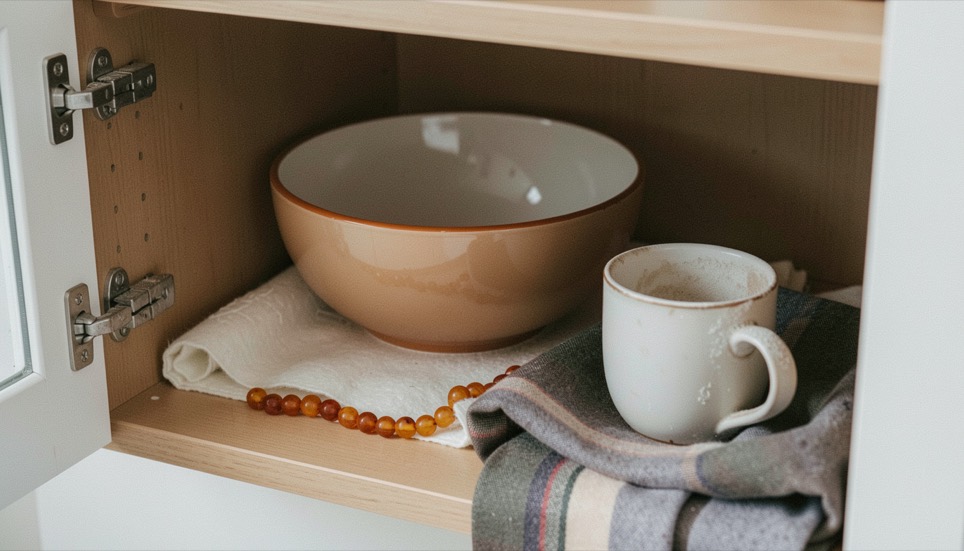
Decorative lighting is part of the object, not an afterthought: a lacquered khokhloma bowl, a brass samovar or a painted nesting doll changes appearance depending on the color temperature and direction of the light that reaches it. Warm white sources, generally placed between 2700 and 3000 kelvin, keep gilding, red lacquer and amber tones legible, while cooler or overly bright sources flatten them and can make hand painted detail hard to read. For collectors, choosing a bulb and a shade is therefore a curatorial act, close to what a museum does when it lights a display case.
The desk has written this guide because lighting questions recur among readers who arrange Russian crafts at home: how bright, how warm, how layered, and with which fittings. The article reads lighting the way this site reads objects, through materials, marks and care.
Why light decides how lacquer and gilding read
Lacquer is a reflective surface, and reflection is the whole problem. A glossy gilded border under a single ceiling fixture produces one hot highlight and a dark field around it, so the brushwork disappears. The same border under two or three lower intensity sources, placed at different angles, distributes the reflection and lets the eye travel across the painted surface.
Color temperature matters just as much. Traditional palettes in Russian folk painting lean on red, gold, black and dark green. Under warm white, around 2700 to 3000 K, the reds stay deep and the gold reads as gold. Under cool white, 4000 K and above, the same reds can look dull and the gold shifts toward a pale straw tone. This is why display practice favors warm sources for polychrome and metallic surfaces, and why dimmable circuits are useful: the same room may need more light for inspection and less for display.
Renders of color, measured as CRI, matter for painted work too. A source with a low color rendering index can shift hues enough that two pieces painted with the same pigment look mismatched on the shelf. Ranges of 90 and above are commonly used where color accuracy is the point.
Readers who want the technical vocabulary in plain terms, lumens against watts, the kelvin scale, warm white against cool white, will find a practical home lighting guide that walks through these measures with concrete room by room examples. The kelvin scale in particular is the one number worth memorizing before buying bulbs for a display wall.
How should a display shelf of Russian crafts be lit?
The working method is layering, the same principle used in comfortable domestic lighting generally: a low ambient level, a mid level for the room’s function, and a narrow, directed layer for the objects. For a shelf of nesting dolls or lacquer boxes, that third layer does the interpretive work.
A few documented practices:
- Place the directed source slightly above and to the side of the object, not square in front, so that highlights fall away from painted faces.
- Keep a small distance between the lamp and the piece, or use LED, which emits little infrared and no ultraviolet compared with older incandescent or halogen technology. Light damage to lacquer and pigment is cumulative and irreversible.
- Avoid the ceiling fixture as the only source. It is the most common cause of flat, unreadable displays.
- Diffuse where possible: a linen shade, frosted glass or a paper diffuser softens the hard edge of a bare LED filament and reduces glare on gloss.
For collectors of brass, the rules bend slightly. Brass and copper, samovar bodies, tray edges, icon frames, benefit from a warmer and slightly stronger key light that brings out the polish. The care routine still governs: regular dusting with a soft dry cloth, because grit under any cloth, in any light, is what dulls a finish.
What kind of lamp suits a Russian style interior?
The question is usually asked the other way around, which lamp looks Russian, and the honest answer is that period Russian interiors were lit with the same international stock as everywhere else: kerosene lamps, then early electric fittings, in styles that ranged from neoclassical to Art Nouveau. What reads as Russian in a lamp is mostly material and proportion rather than ornament.
Materials that sit well beside collected crafts are brass, dark patinated bronze, opaline and frosted glass, turned wood and painted wood. A table lamp with a carved and painted wooden base sits naturally next to a matryoshka display; a brass stem lamp belongs beside the samovar, which after all was itself a brass object of display when not in use.
Shades deserve as much attention as bases. A dense fabric shade in deep red, oxblood or dark green filters light warm and echo the palette of the objects. A white paper or linen shade gives a cleaner, more neutral field, useful if the collection includes pale woods such as unpainted linden, common in the plainer nesting doll styles.
The Victoria and Albert Museum, whose conservation guidance on light and object damage is published on its website, frames the issue plainly: light is a form of energy that causes fading and structural change in sensitive materials, and exposure accumulates over an object’s life. That logic, scaled down from gallery to shelf, is the collector’s rule: light the piece when it is being seen, not around the clock.
How many lamps, and where, in one room?
A room that holds a collection usually needs three to five light sources rather than one or two, and their placement follows the furniture and the objects, not the ceiling. A workable arrangement for a typical living room:
- One floor lamp in a corner, angled into the seating area, carrying the ambient layer at warm white.
- One table lamp at reading height, dimmable, for the functional layer.
- One or two small directed sources, picture lights or adjustable spot fittings, reserved for the objects.
- Where wiring allows, a programmable scene that sets all three layers at once, one setting for evening display, one brighter for examining a piece in hand.
This layering approach, with scenes and color temperature adjusted to the room’s use, is standard practice in modern interior lighting, and programmable warm to cool sources make it possible to shift a room from a work setting to a display setting without moving a single lamp. The same circuits that suit a reading chair suit a display cabinet: what changes is the temperature chosen, warmer for lacquer and brass, neutral for unpainted wood and paper.
Dimming has a second, quieter benefit. Hand painted work rewards low light in the evening, when the eye is more sensitive and small details in dark backgrounds become easier to see. A piece that looks inert under a bright ceiling can become the center of a room at a quarter of that intensity.
Care, safety and the long life of the fitting
Lighting a collection well also means maintaining the lighting. Fittings near textiles, drapes or lacquer should be checked for heat, one of the practical reasons LED technology, which runs cooler than incandescent, has been widely adopted for display use. Fixtures should be dusted with the objects, since dust on a bulb or shade absorbs light and shifts its color.
Older lamps, especially wired brass pieces bought as antiques, deserve an inspection of cord, plug and socket before regular use, and rewrapping by a qualified electrician where the insulation has aged. A period lamp is an object like any other in the collection: it is read through its materials and its marks, and it is cared for accordingly.
The final principle is restraint. Light exists in a Russian interior to let the objects speak: one warm directed beam on a gilded edge, a low wash across a shelf of painted figures, and darkness or near darkness elsewhere. The collector who controls the light controls the story the room tells, and no amount of ornament in the lamp itself will do that work better than a well chosen bulb at the right temperature, placed at the right angle, and switched off when the viewing is done.